What Makes One North Different from Other Singapore Neighbourhoods?
You’ve probably walked through dozens of Singapore neighbourhoods, each with its own character. But One North feels different the moment you arrive.
The streets hum with a distinct energy. Research scientists grab coffee next to startup founders. Cyclists weave past contemporary art installations. Green corridors connect modern office towers to residential enclaves.
This isn’t your typical business district or bedroom community. One North was designed from the ground up as Singapore’s answer to Silicon Valley, but with a uniquely local twist.
One North Singapore neighbourhood stands apart as a purpose-built innovation district combining biomedical research facilities, media studios, tech startups, and residential spaces within a pedestrian-friendly environment. Unlike traditional commercial zones, it integrates work, leisure, and living through extensive green corridors, cultural venues, and mixed-use developments that foster collaboration across industries while maintaining strong connectivity to central Singapore.
Built for innovation from day one
Most Singapore neighbourhoods evolved organically over decades. One North took a different path.
The government launched this precinct in 2001 with a clear vision. Create a space where researchers, entrepreneurs, and creative professionals could collide and collaborate.
The master plan carved out three distinct clusters. Biopolis focuses on biomedical sciences. Fusionopolis houses physical sciences and engineering. Mediapolis caters to media and digital industries.
Each cluster operates independently yet connects through shared amenities and transport links. This structure encourages cross-pollination between sectors.
Walking through One North today, you’ll spot global pharmaceutical giants next to homegrown startups. Research institutes share courtyards with design studios. The physical layout literally brings different industries together.
Green spaces that actually get used
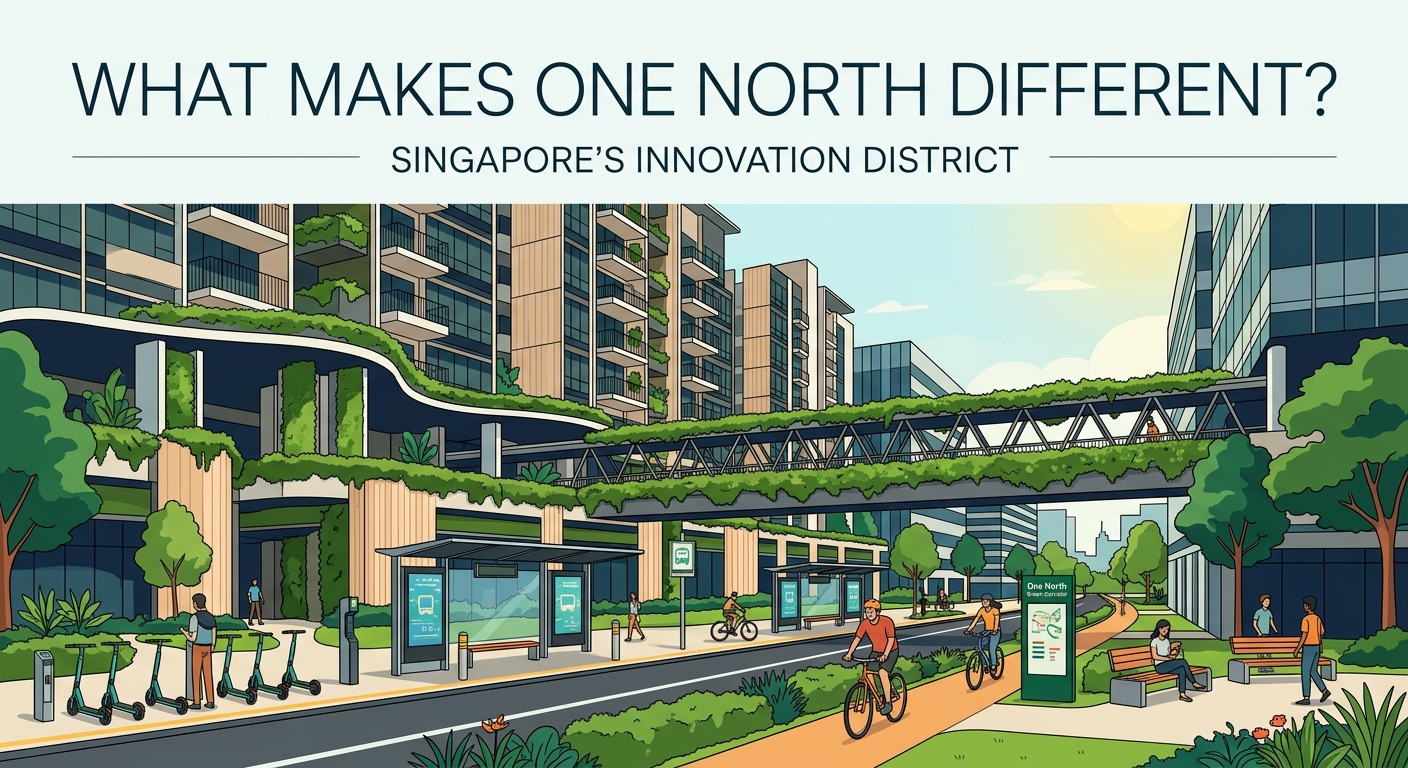
Singapore loves its gardens, but One North takes greenery seriously in a practical way.
The neighbourhood features over 50 hectares of parks and open spaces. These aren’t just decorative patches of grass. People actually use them.
Labrador Nature Reserve sits at the southern edge, offering coastal trails and historical sites. Alexandra Canal Linear Park cuts through the centre, providing a shaded cycling route that connects to the wider park connector network.
Between the office blocks, you’ll find pocket gardens with seating areas. Workers eat lunch under rain trees. Families picnic on weekends. Joggers loop through the paths during evening hours.
The green corridors serve a functional purpose too. They reduce urban heat, manage stormwater, and create natural breaks between different zones.
Living where you work becomes realistic
Many Singapore professionals spend hours commuting. One North residents often walk to their offices.
Several residential developments have sprouted within and around the precinct. The Metropolis towers over Buona Vista MRT. Wessex Estate offers landed homes minutes from research labs. Newer condos like The Interlace and Reflections at Keppel Bay sit on the periphery.
This proximity changes daily routines. Parents drop kids at nearby schools before heading to work. Couples meet for lunch without leaving the neighbourhood. Evening activities don’t require elaborate transport planning.
The mixed-use approach means amenities cluster naturally. Supermarkets, clinics, gyms, and cafes locate near residential areas because the demand exists.
“Living in One North cuts my commute from 90 minutes to 15 minutes daily. That’s an extra 2.5 hours I get back every day. Over a year, that’s literally weeks of my life returned.” — Research scientist at Biopolis
Transport links that actually connect
Good transport separates liveable neighbourhoods from frustrating ones. One North scores well here.
Buona Vista MRT station serves as the main hub. The Circle Line and East-West Line intersect here, connecting you to Dhoby Ghaut in 15 minutes or Marina Bay in 20 minutes.
Bus services run frequently through the precinct. Routes 74, 92, 95, 191, and 200 cover different zones within One North and link to surrounding areas.
Cycling infrastructure gets serious attention. Dedicated paths connect residential areas to office clusters. Bike parking appears at most major buildings. The park connector network lets you cycle to Alexandra, Queenstown, or even Marina Bay without fighting traffic.
For drivers, the Ayer Rajah Expressway runs along the northern edge. Getting to Orchard takes about 10 minutes outside peak hours. Changi Airport sits 30 minutes away via expressway.
Food options beyond the usual suspects
Office districts often suffer from boring lunch options. One North breaks this pattern.
The Star Vista mall provides mainstream chains and casual dining. Rochester Mall offers more neighbourhood-focused options. Smaller clusters of shophouses and converted buildings house independent cafes and restaurants.
Fusionopolis and Biopolis have their own food courts and canteens. These serve the daily crowd but also attract outsiders looking for affordable meals.
The surrounding neighbourhoods add depth. Holland Village sits 10 minutes away by bus. Queenstown’s hawker centres and coffee shops provide authentic local fare. Alexandra Village Food Centre became a destination for traditional dishes.
Weekends see food trucks and pop-up markets at various green spaces. The variety shifts seasonally, keeping things fresh.
Cultural spaces woven into the fabric
Innovation districts can feel sterile without cultural anchors. One North addresses this through several venues.
The Star Performing Arts Centre hosts theatre productions, concerts, and dance performances. Gillman Barracks transformed former military buildings into contemporary art galleries. Multiple commercial galleries showcase Southeast Asian and international artists.
The Rochester Park enclave preserves colonial black-and-white bungalows, now housing restaurants and creative businesses. The architecture provides historical contrast against the modern towers.
Public art installations dot the landscape. Sculptures, murals, and interactive pieces appear in parks, plazas, and building lobbies. These aren’t afterthoughts but integrated elements of the urban design.
Education options for families
Families considering One North need to think about schools. Several options exist within reasonable distance.
- CHIJ Kellock is a Catholic girls’ primary school located right at the edge of One North
- Fairfield Methodist Schools (Primary and Secondary) sit in nearby Dover
- Anglo-Chinese School (Independent) operates in nearby Dover Road
- National University of Singapore and INSEAD provide tertiary options within the precinct itself
International schools like Singapore Polytechnic International and various preschools serve expatriate families. The proximity to NUS also means student housing and youth-oriented facilities cluster nearby.
What makes it different from other business districts
Let’s compare One North to other Singapore commercial areas:
| Aspect | One North | CBD/Marina Bay | Jurong Gateway | Paya Lebar Quarter |
|---|---|---|---|---|
| Primary focus | Innovation clusters | Finance & corporate HQ | Manufacturing & logistics | Mixed commercial |
| Residential integration | High, multiple condo clusters | Low, mostly transient | Medium, growing | Medium, new developments |
| Green space ratio | Very high, 50+ hectares | Low, limited parks | Medium, planned parks | Low, urban density |
| Cultural venues | Galleries, theatres, heritage sites | Museums, event spaces | Shopping malls | Mainly retail |
| Cycling infrastructure | Extensive, integrated | Limited, improving | Basic | Basic |
| Industry diversity | Biotech, media, tech, education | Finance, law, consulting | Industrial, retail | Retail, tech, offices |
The table shows One North’s unique positioning. It combines work opportunities with lifestyle amenities more successfully than traditional business districts.
The startup ecosystem advantage
Entrepreneurs find One North particularly attractive for several reasons.
JTC operates several incubation facilities within the precinct. LaunchPad @ one-north provides affordable space for early-stage companies. Larger tech firms run their own accelerator programs here.
The concentration of research institutes creates partnership opportunities. Startups can tap into academic expertise at NUS, collaborate with A*STAR researchers, or license technologies from public labs.
Networking happens organically. Coffee shops and coworking spaces become informal meeting points. Industry events and seminars occur regularly at various venues.
Venture capital firms and corporate innovation teams maintain offices here. Fundraising conversations can happen over lunch rather than requiring separate trips across the island.
Challenges worth acknowledging
No neighbourhood is perfect. One North has trade-offs worth considering.
Property prices run high. Both rental and purchase costs exceed many other Singapore locations. This reflects the premium location and amenities but can strain budgets.
The area can feel quiet outside working hours. While improving, One North lacks the 24-hour buzz of established neighbourhoods. Some find this peaceful; others miss the energy.
Retail options remain limited compared to mature estates. You won’t find the shopping variety of Orchard or Tampines. Most residents supplement with trips to nearby areas.
School options, while present, don’t match the density of older residential zones. Families may face longer commutes for specific institutions.
The precinct still feels somewhat car-centric despite good public transport. Wide roads and spread-out clusters mean walking everywhere isn’t always practical.
Who thrives here
Certain profiles fit One North particularly well:
- Professionals working in biotech, media, or tech industries
- Couples without school-age children prioritizing lifestyle and commute
- Entrepreneurs building companies in innovation sectors
- Expatriates on corporate packages seeking modern amenities
- Active individuals who value cycling and outdoor access
- Creative professionals wanting proximity to galleries and studios
Families with young children can make it work but need to carefully consider school locations. Retirees might find it too work-focused compared to more established neighbourhoods.
The neighbourhood keeps evolving
One North remains a work in progress. New developments continue launching.
The Greater Southern Waterfront masterplan will eventually connect One North to the coast. This long-term project promises to add waterfront amenities and recreational spaces.
More residential projects are in the pipeline. As the working population grows, developers respond with housing options at various price points.
Transport improvements continue. The Circle Line extension studies could add more connectivity. Cycling infrastructure expands annually.
The precinct is young by Singapore standards. Most buildings date from the 2000s onwards. This means infrastructure remains modern, but also means the neighbourhood lacks the patina of history.
Making the move work for you
If you’re seriously considering One North, take these steps:
- Visit at different times: weekday lunch, evening, and weekend to gauge the vibe
- Test your actual commute if your workplace sits elsewhere
- Map out schools if you have children, calculating realistic travel times
- Check which specific cluster aligns with your work or interests
- Compare property costs against other neighbourhoods with similar amenities
- Spend time in the parks and public spaces to see if they suit your lifestyle
Talk to current residents if possible. Online forums and property groups can connect you with people already living there.
Consider renting before buying. A year’s experience will reveal whether One North truly fits your needs.
Why this neighbourhood rewards certain choices
One North Singapore neighbourhood works best when you align your life with its strengths.
Choose housing close to your work cluster. The commute savings compound daily into significant time gains. Pick a unit near green corridors if you value outdoor access. Prioritize developments with good amenities if you want to minimize trips elsewhere.
Embrace the cycling infrastructure. A good bike transforms how you experience the precinct. Distances that feel far on foot become manageable rides.
Engage with the innovation community. Attend talks, join interest groups, visit galleries. The neighbourhood’s value increases when you tap into its networks.
Accept that you’ll still travel for certain needs. One North excels at specific things but can’t replace all of Singapore. Knowing when to venture out prevents frustration.
The neighbourhood rewards people who want to collapse the boundaries between work, learning, and lifestyle. If that describes you, One North might just be the Singapore address that changes how you live.